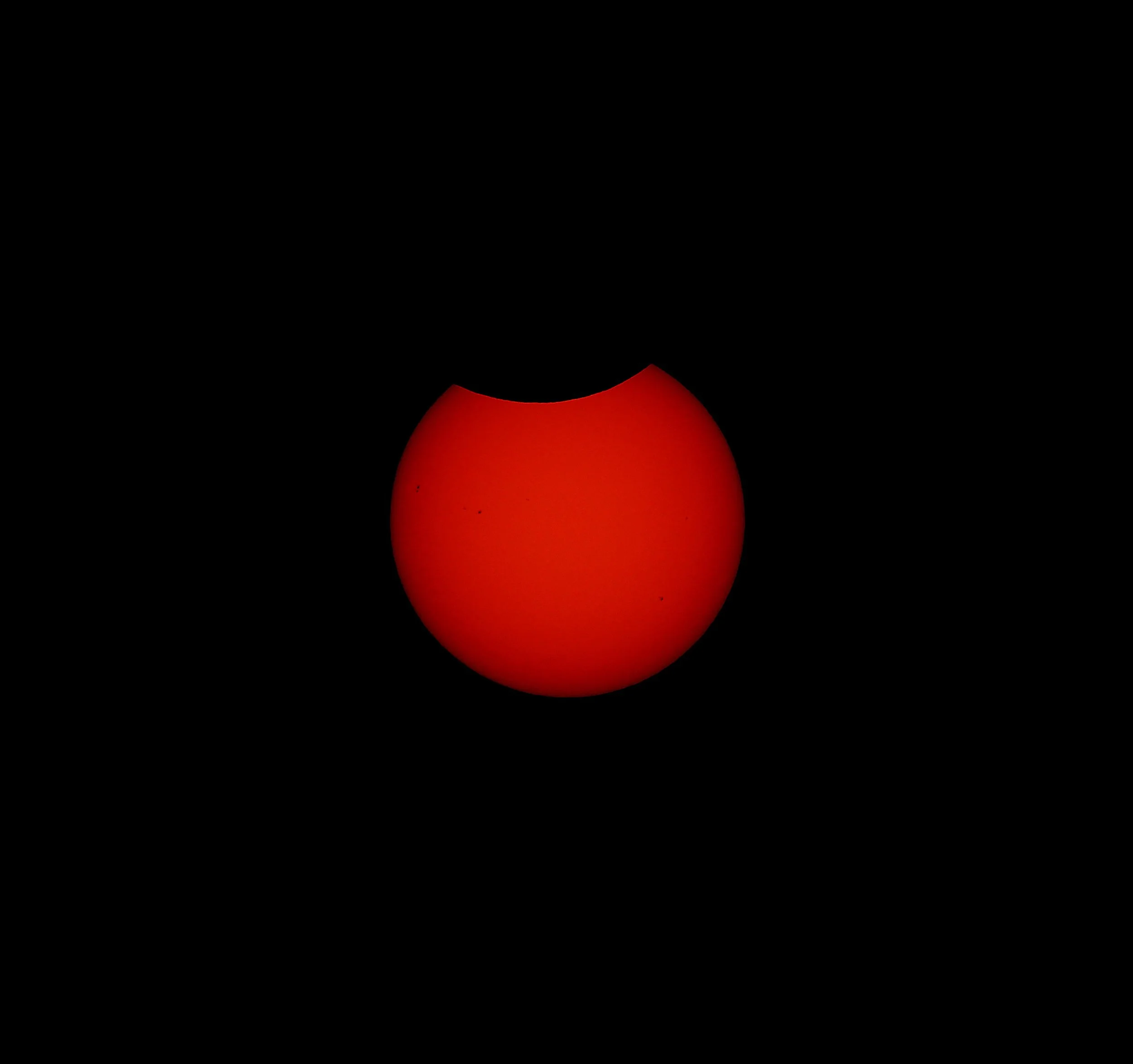
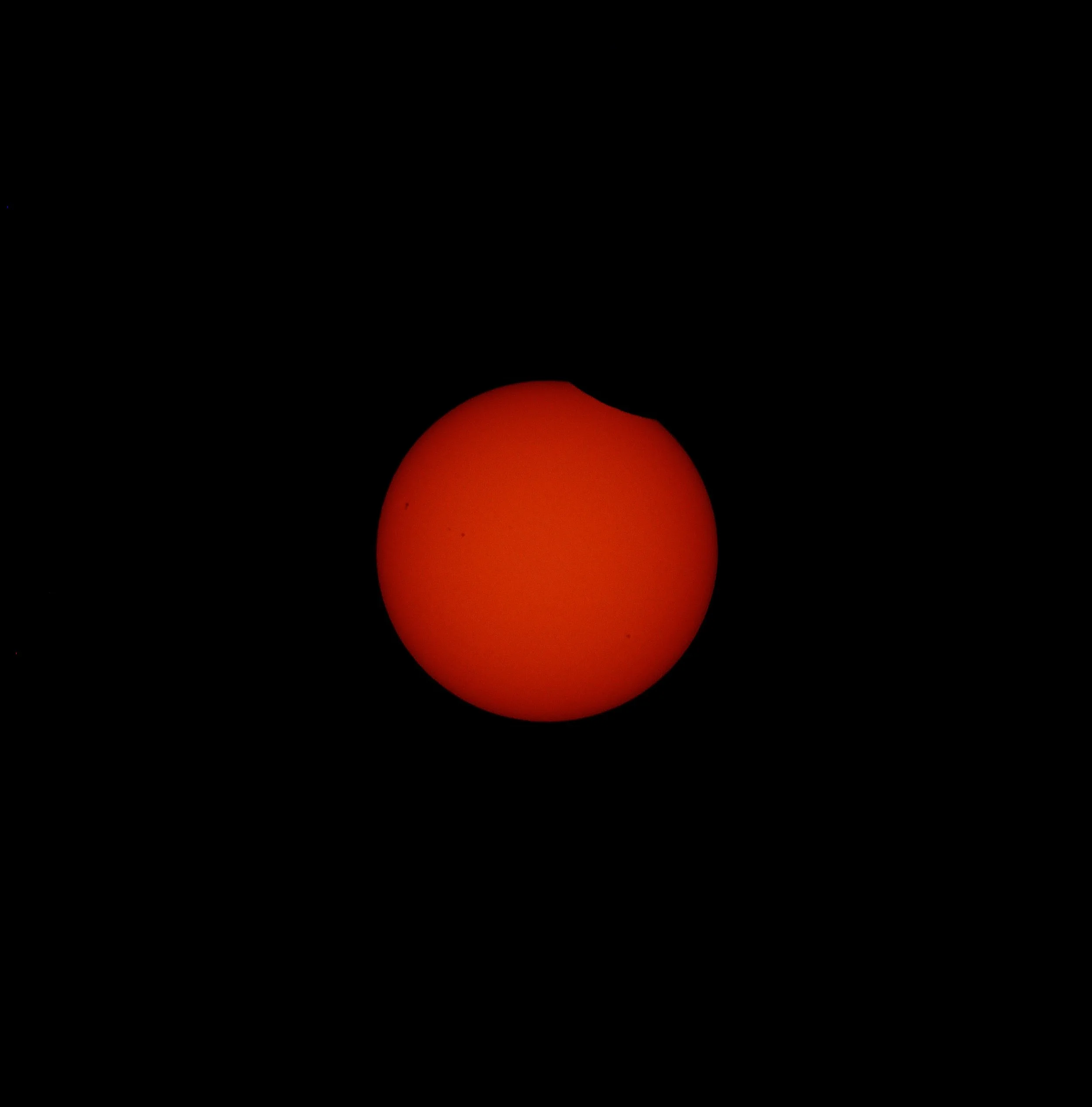
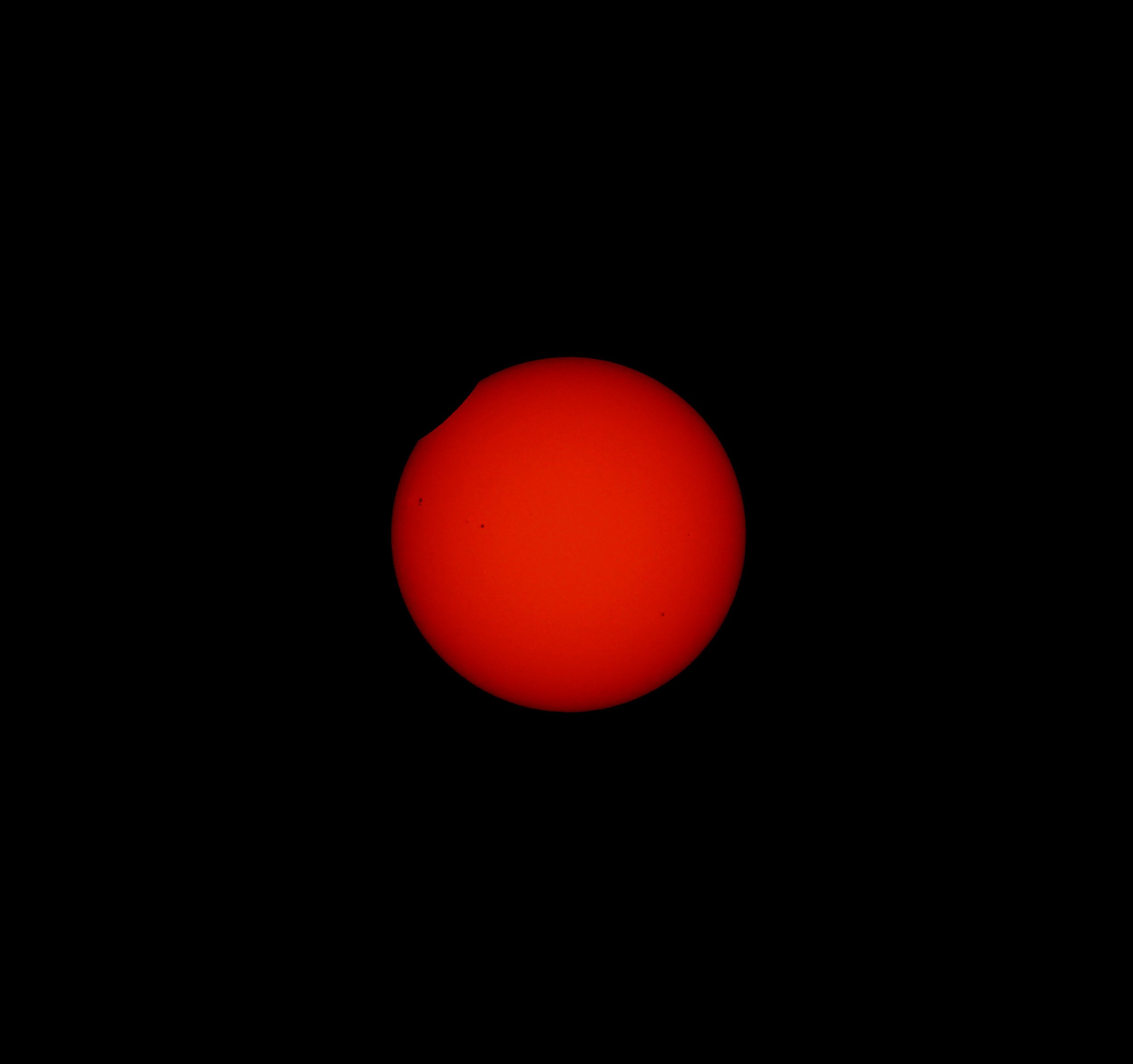
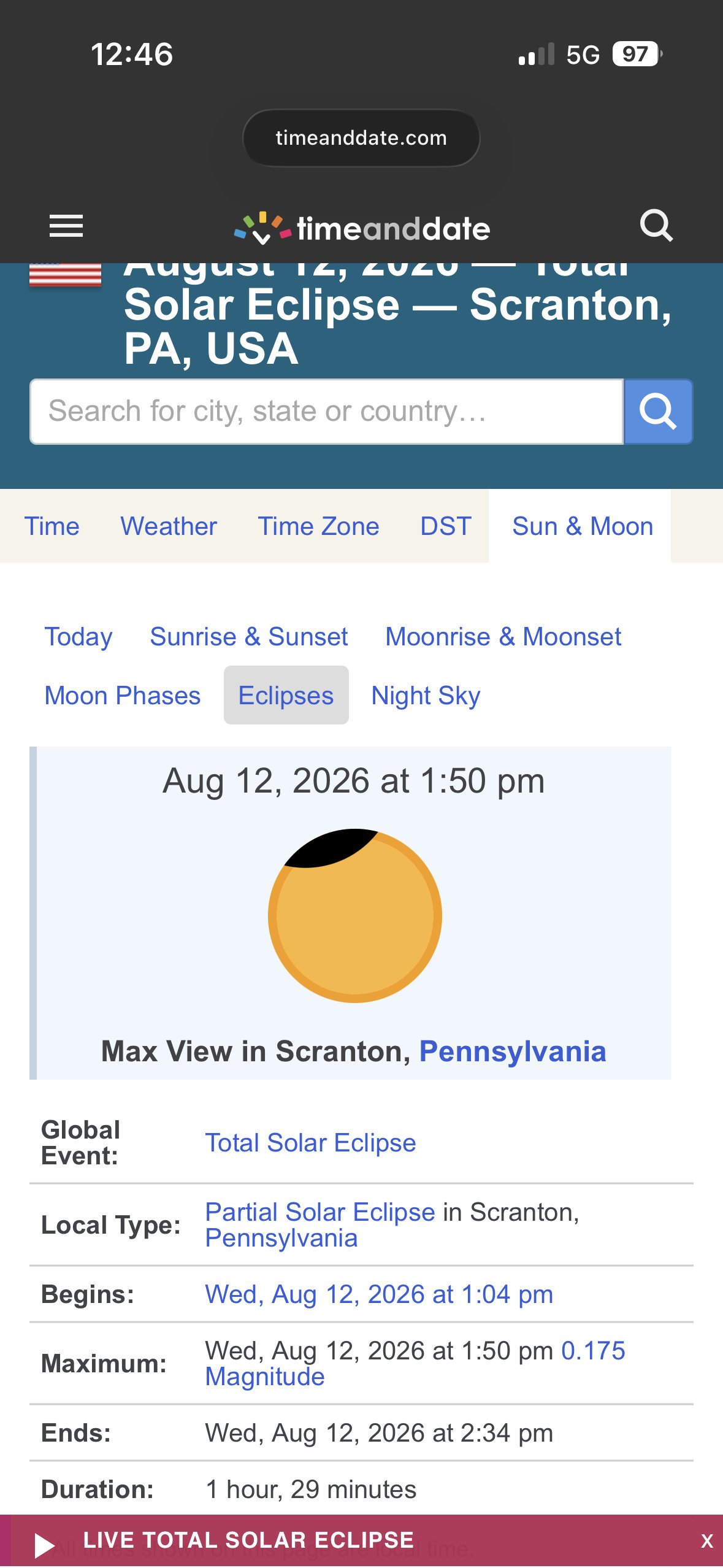
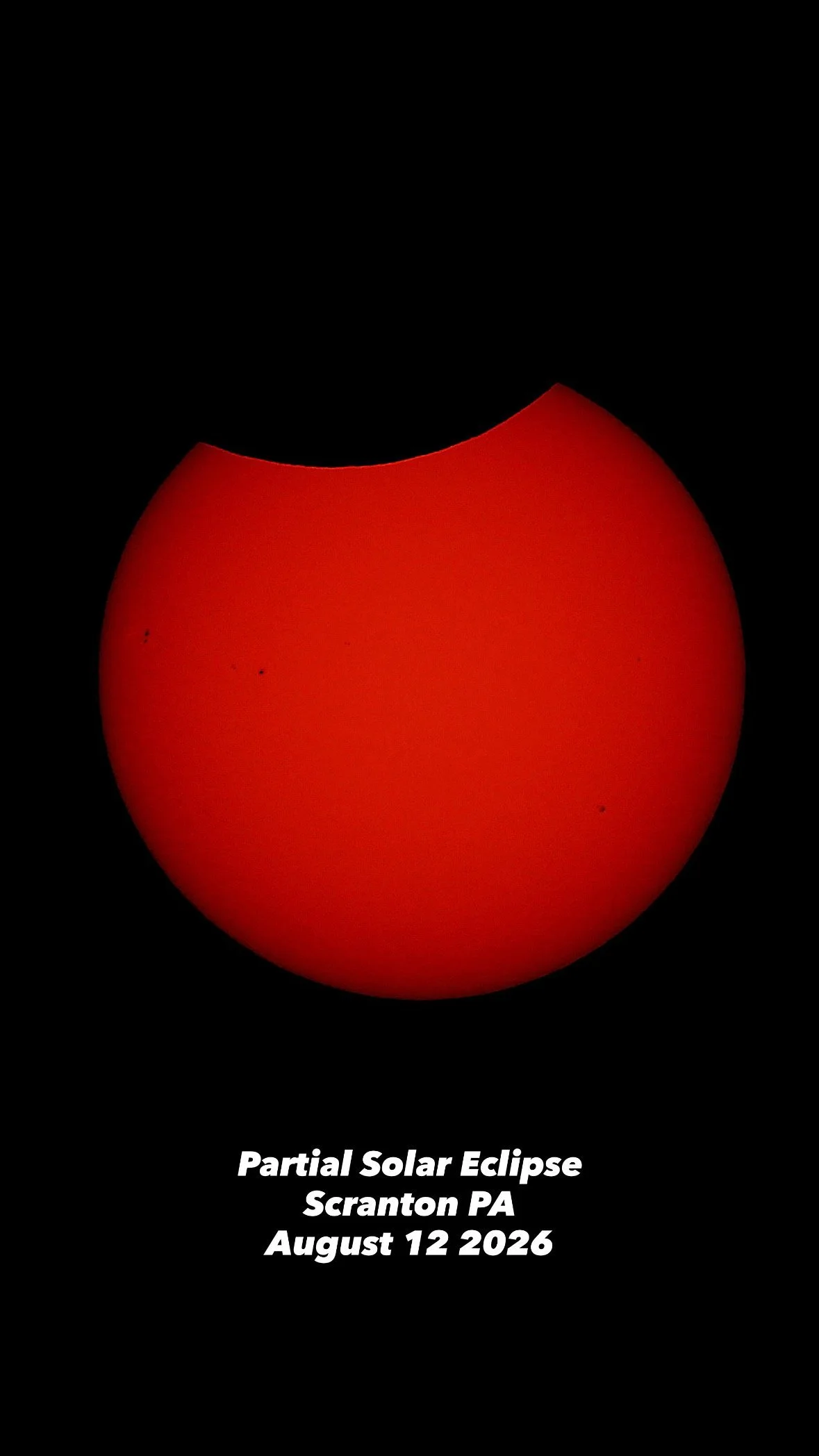
PLEASE SCROLL DOWN FOR PHOTOS. The Partial Solar Eclipse of 2026. This was a partial solar eclipse at my viewing location in Scranton, PA, USA on August 12, 2026. But across the Atlantic Ocean in Greenland, Spain and Portugal, folks there were treated to a total solar eclipse. And in Spain, an absolute treat: a sunset eclipse!
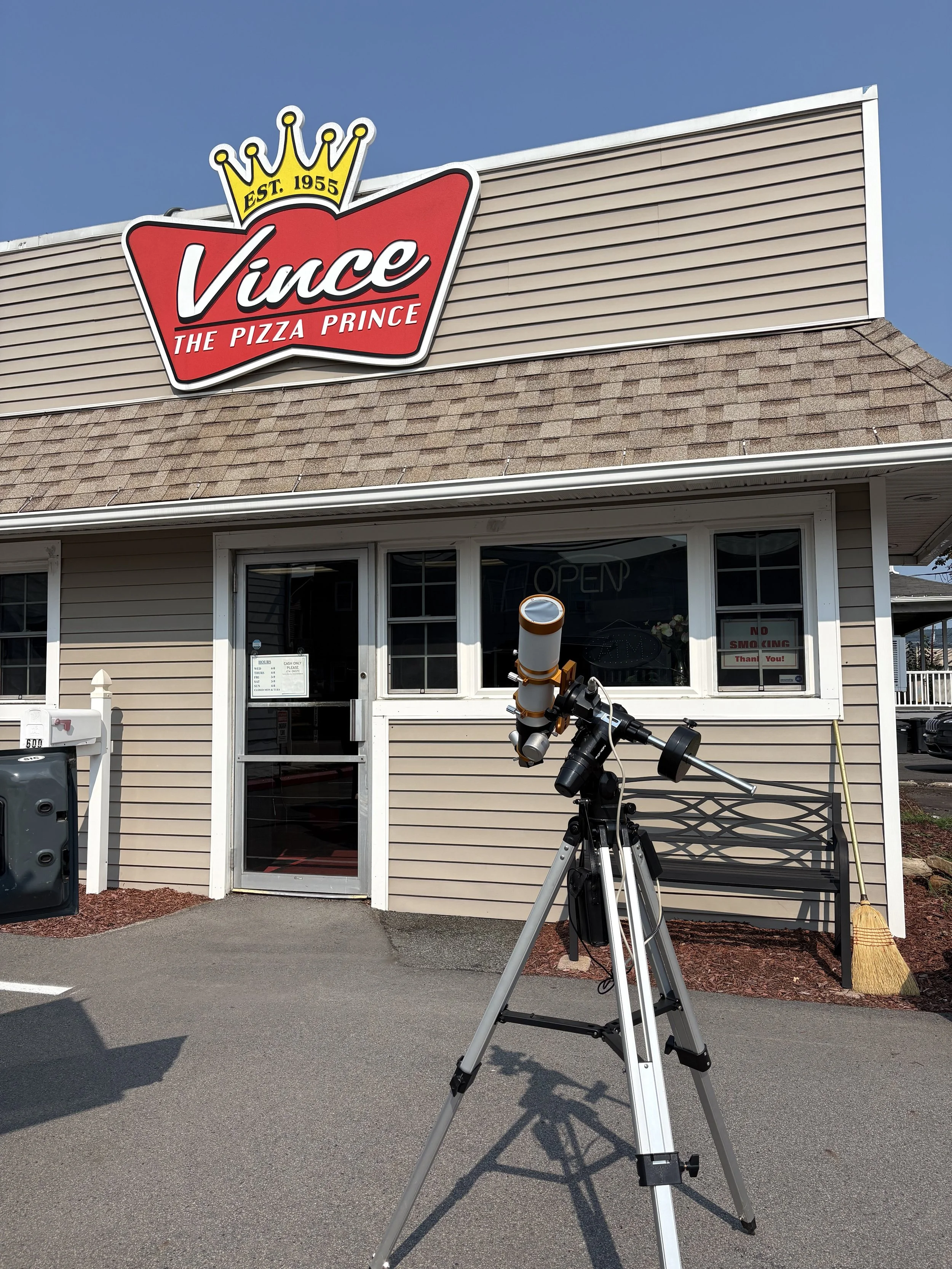
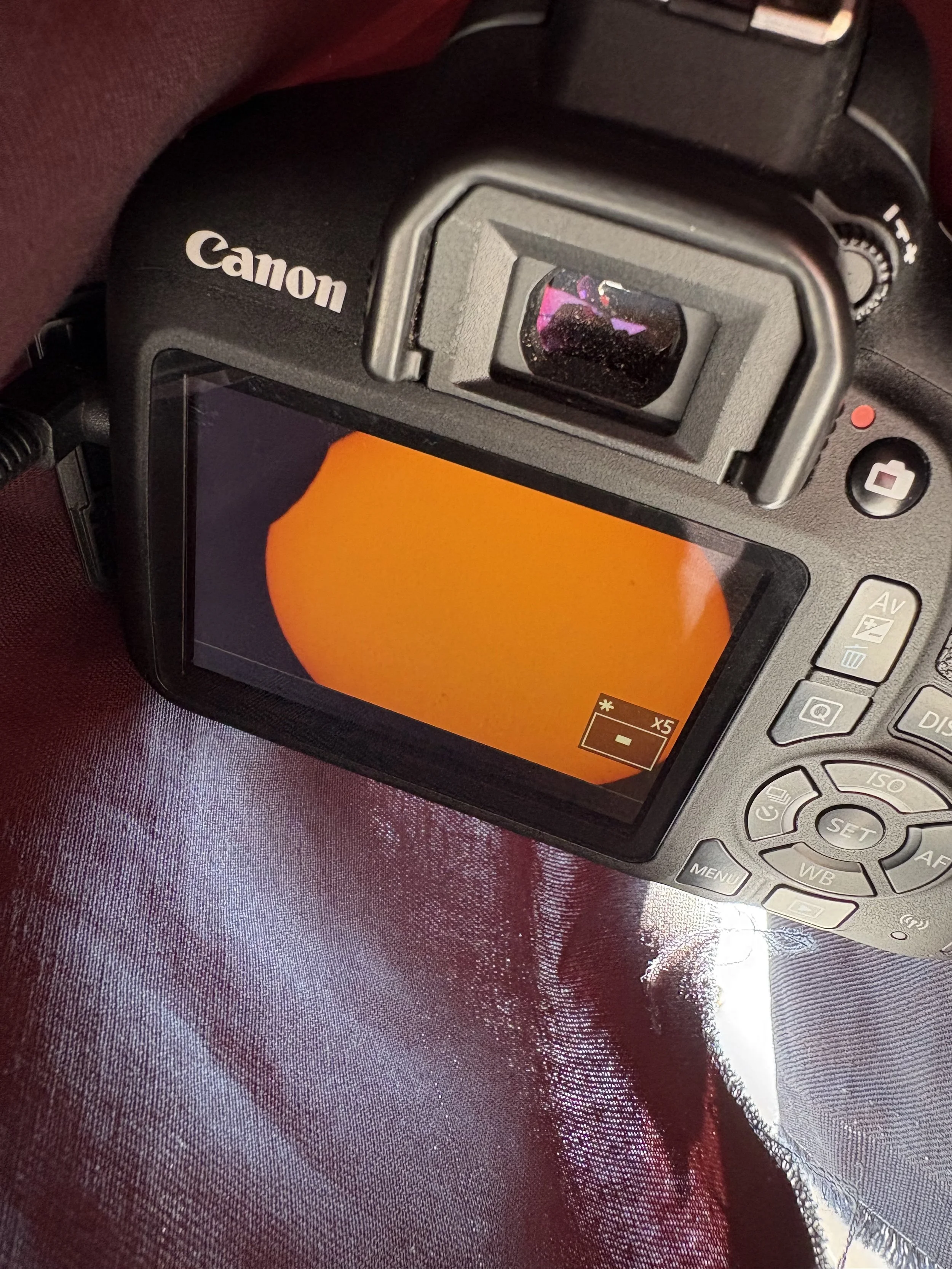
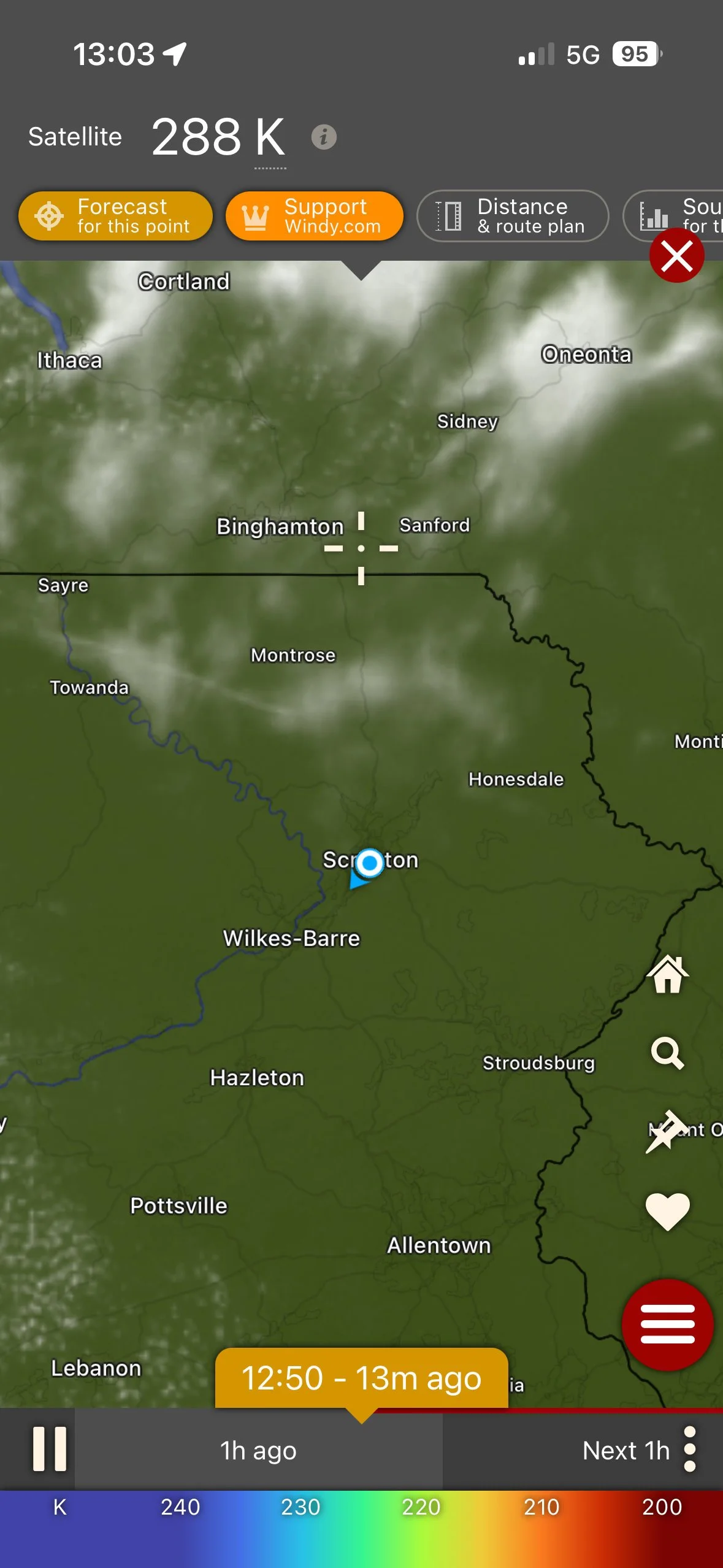
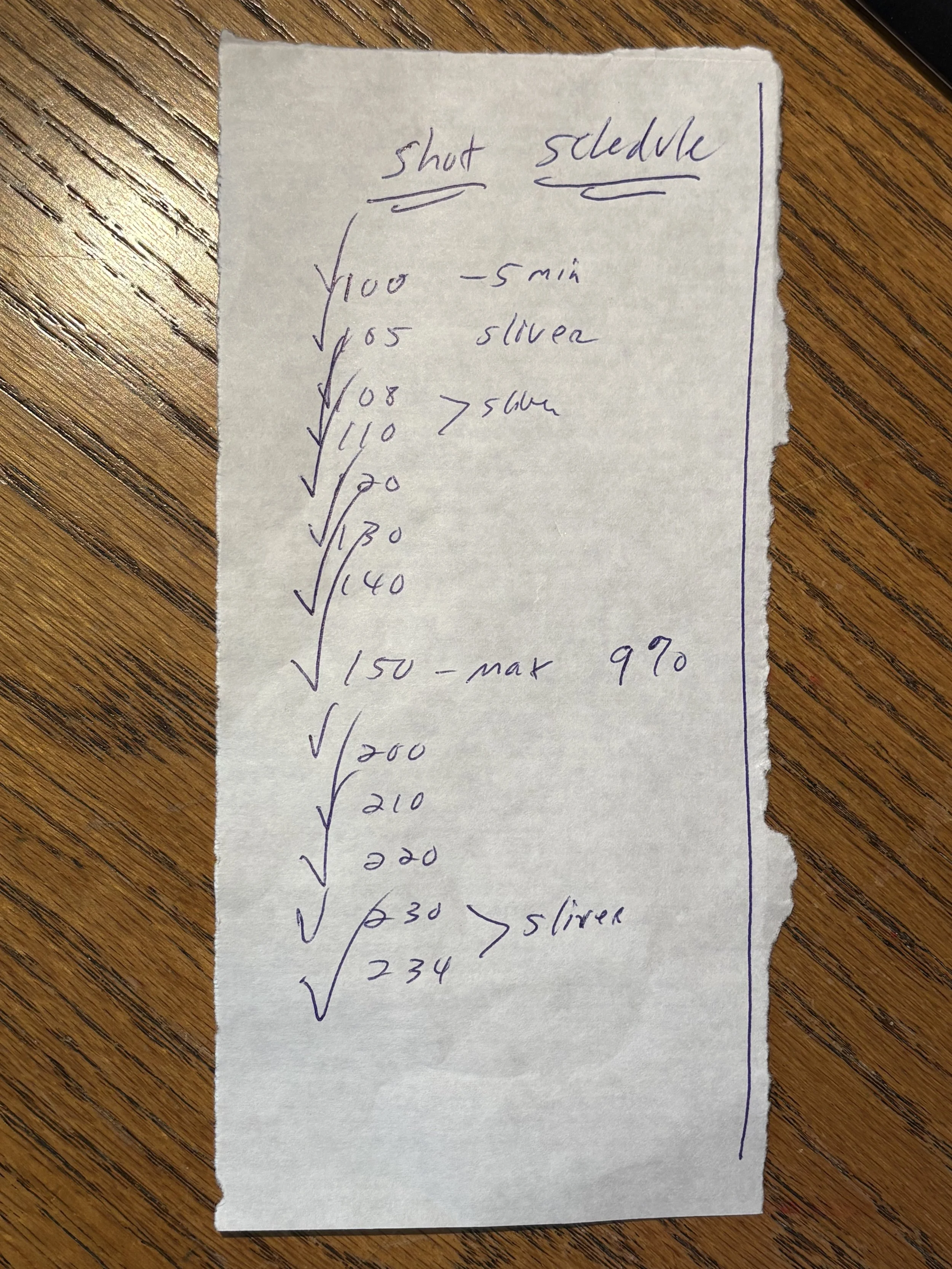
It was a perfect afternoon for a solar eclipse. Light winds, clear skies, and warm weather, a lovely August afternoon in Pennsylvania. My William Optics Zenithstar Z73 apo refractor (pictured on the homepage) with solar filter, and my Canon T7 camera attached at the eyepiece end, was all set up and ready to shoot! I used Thousand Oaks solar film for my solar filter, custom built into a fit-on cap at the end of my telescope. My shooting location was very special, at my family owned pizzeria in south Scranton, PA. It was a Wednesday afternoon, and I had to get the food deliveries and thus I had to be there, and so that determined where I was going to photograph this solar eclipse! With my shot schedule all planned out and written down (photo below) I began to shoot.
Partial solar eclipses can be a bit exciting, but nothing like a total solar eclipse, and they also can be a bit underwhelming. The latter is what this eclipse happened to be. But hey, how often does the Moon grace itself in front of the Sun here right at home? Coverage of the Sun was just a tad but shy of 10% of the solar disc, but again, why miss it? At this level of coverage, the very cool optical phenomenon that can occur with a partial solar eclipse were just not possible. That being the ability to view the crescent shape of the partially eclipsed Sun thru openings in the leaves of trees, through holes in kitchen colanders, Ritz crackers, and homemade pinhole camera devices. The Sun is just too bright and the small portion of eclipsed coverage is not enough to overcome the solar brightness to see the crescent. (please see my page on the annular eclipse in Arizona for pictures of this optical effect).
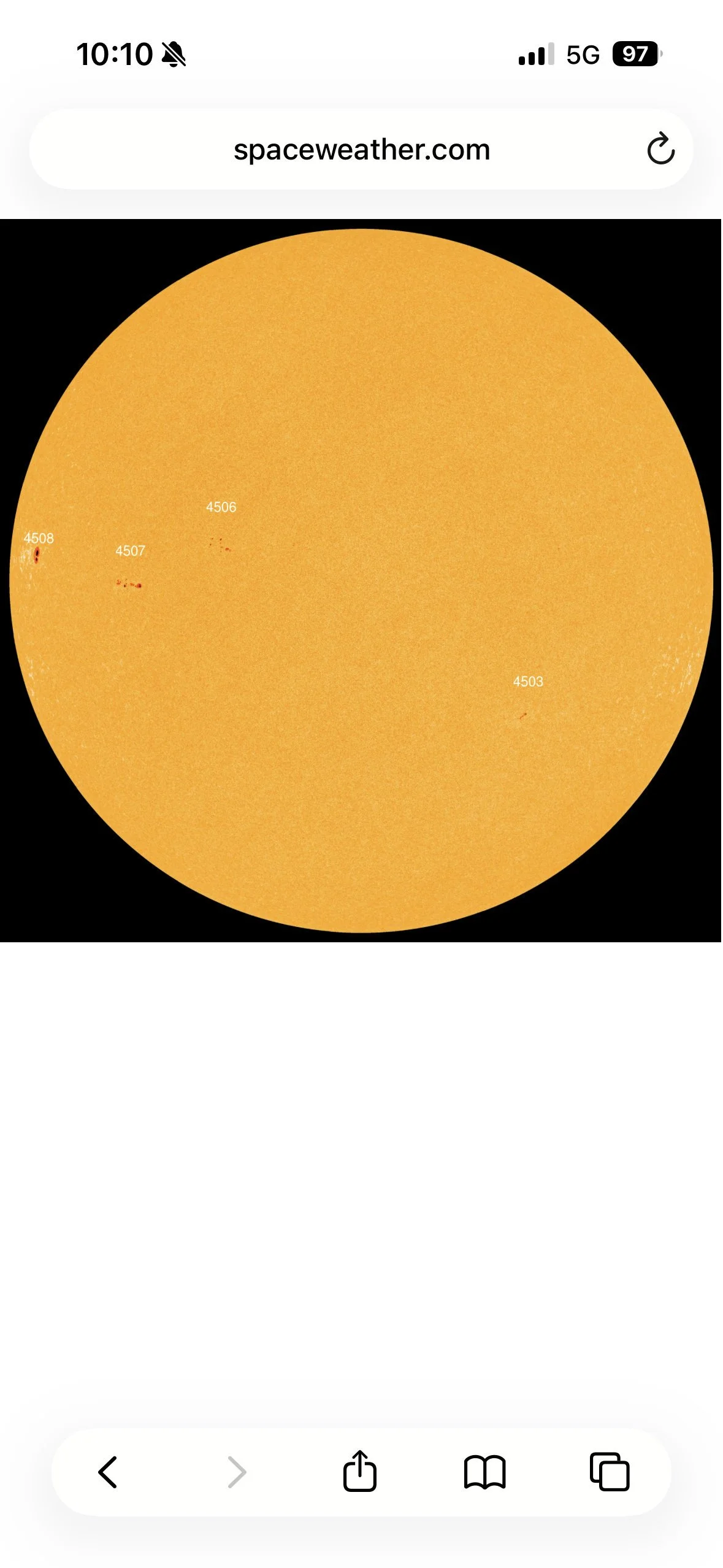
It’s always exciting to view the Moon starting to pass in front of the Sun at the beginning of a solar eclipse. It’s always right on time at the predicted moment, and it always get you wondering just how far humans have become with technology and the ability to predict exactly when the eclipse will occur at any given location on the Earth. And so here I was again seeing that first “bite” of the Sun by the Moon and witnessing one of nature’s most incredible spectacles! As the eclipse progressed, I took my shots every 10 minutes or so, taking 3 or 4 shots at a time using different exposures to get a range of brightness’s so I could choose which shots were best for processing. Around 1:50 pm maximum eclipse was achieved in Scranton, PA, and after that it was downhill from there! I continued to shoot until the very last perceptible bit of the Sun was covered by the exiting Moon. I used my Corel software to process a few of the images and I invite you to scroll down and see the great results. You’ll notice sunspot groups 4508, 4507 and 4503 spread across the Sun from left to right in the solar shots below. It’s always great to have some sunspots visible when shooting an eclipse. They make it easy to get good focus of the surface of the Sun.
The next solar eclipse in Scranton, PA will be on January 26, 2028. It will be a very thin, partial eclipse occurring in the morning very close to the horizon. With the Sun at 22 degrees high, and January cold weather, and high prospects for cloud cover, this will be a challenging solar eclipse to view. Unless perhaps one can get to the coast, in the cold sand, for viewing! After that, the next solar eclipse will be on January 14, 2029. That one will be a bit more exciting as the Sun will have nearly 50% coverage by the Moon! Occurring before, during and after noontime, this partial solar eclipse will be fairly easy to view in Scranton, PA at some 27 degrees above the horizon. But again, one will have to fight the cold of January, and the nearly 90% chance of cloud cover (source: timeanddate.com).
The next partial solar eclipse occurs March 30, 2033.
Finally if you want to view a total solar eclipse of the Sun in Scranton, PA, you will have to wait until May 1, 2079, with totality occurring just seconds after sunrise!! Right on the horizon!